Maybe we’ve been measuring success in the wrong way.
Michael Murray, Assistant Director of Athletics, The Albany Academy
Every spring, I observe a familiar tradition, not just as a teacher but also as a coach who has watched young people develop over many years on pool decks and in schools. Academy families gather around kitchen tables and screens, eager with anticipation. Parents monitor online portals closely, while students pause to share decisions that seem, perhaps, to be one of the most significant achievements of their lives. The moment sparks joy: signing days at Caird Chapel, photos in college gear, signs raised high, and social media flooded with pride.
They have earned that right. Every student has put in a lot of effort, made sacrifices, and truly deserves to feel proud of their achievements.
However, I've started to question whether this is truly how we define the value of an education. It seems that over the last few decades, we started equating a school's return on investment with the name on a sweatshirt. Often, we speak of acceptance rates as though they are the ultimate measure of childhood success. Comparing schools as if prestige alone guarantees preparation, celebrating outcomes without reflecting on growth. We seem to deeply crave the attention that comes with a “brand name” collegiate acceptance; we drop it at cocktail parties, reunions, and attach it to our social platforms.
I believe we must proceed with caution. The real return on investment in education has never been about where a student attends college; it's about who they become throughout the process. Fostering strong relationships and mentorship is critical to that transformation. This distinction is more important now than ever, especially in an age that seems to have lost respect for failure as part of the journey, a crucial phase for the development of young people.
The world our students will enter values how you show up far more than where you started. It rewards curiosity over certainty, collaboration over competition, adaptability over memorization, and emotional intelligence over individual accolades. After their Academy journey is complete, what truly matters is whether our young people can solve problems, communicate effectively, build trust, and lift those around them.
These essential skills aren't often featured in college brochures; they are nurtured over time in schools that understand their mission isn't just to prepare students for applications but for life. This is where schools like Albany Academy can make a significant impact.
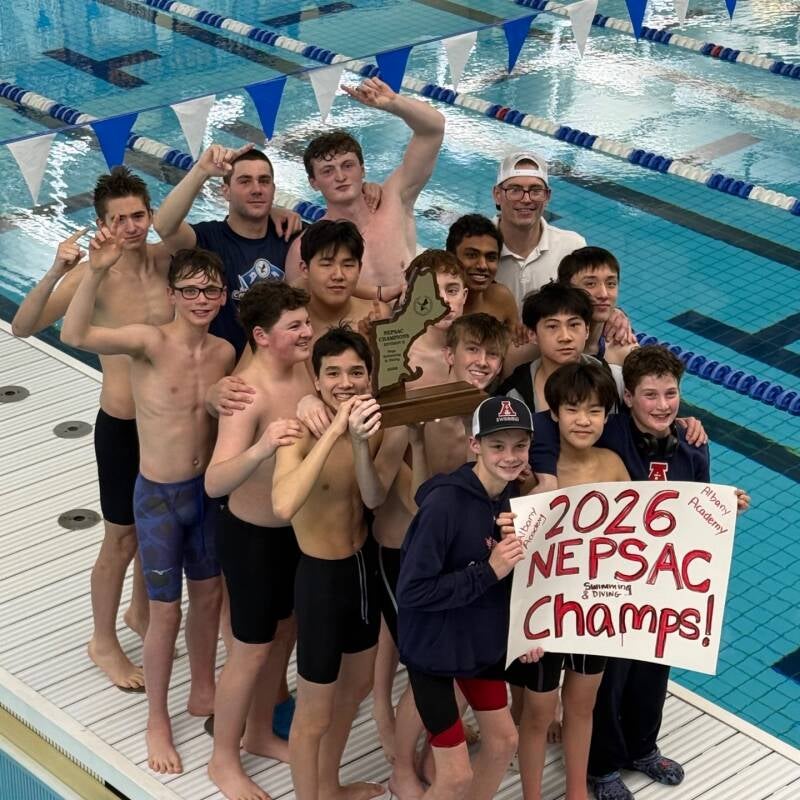
A quality prep school is not merely about statistics or access to elite colleges; it represents a thriving community where young individuals are shaped daily, whether on the field, court, ice, in the pool, in the classroom, at chapel, during rehearsals, in advisory sessions, or in unstructured moments in the student center and the Buttery.
The focus shouldn't just be on crafting impressive résumés; it should be on developing exceptional individuals. This represents a fundamentally different kind of investment.
One of the most valuable insights I've gained as a coach is the curiosity that young people bring to their journeys. This is evident daily in my sport: a senior swimmer asks why we train a certain way, while a first-year athlete wonders about how to change their stroke technique. They freely ask, "Why?"
However, this instinct can diminish as students grow older. As they progress, their curiosity often shifts towards performance, changing the nature of their questions from “What am I interested in?” to “What will be on the test?” or “What do I need to succeed?” As learning becomes a transaction, exploration appears riskier, and the joy of discovery is overshadowed by pressure.
The real tragedy isn't that students become less capable; it's that they become less curious. I believe institutions like Albany Academy have an opportunity to teach our students to strive against this trend.
We create environments where asking thoughtful questions is as valuable as providing correct answers, where students are encouraged to wrestle with ideas, challenge assumptions, and embrace the discomfort of uncertainty. Real learning goes beyond providing answers; it cultivates independent thinkers.
Mr. Zabinski’s advice to “question everything about history” stands out as one of the most crucial lessons learned at the Academy; this approach is encouraged at the middle school level.
In my experience, curiosity is a reliable indicator of long-term success. As knowledge, technology, and industries evolve, especially with AI reshaping our world, a curious mind remains open to learning. Additionally, pressuring students to define themselves prematurely can have adverse effects.
Very few seventeen-year-olds know what they want to pursue. I certainly didn’t; my plans for a career in a sport were based on minimal knowledge at the time. We shouldn’t expect clarity as we walk across Caird Field to receive diplomas. But we often push students towards early specialization: one identity, one path, one definition of success, before they have the chance to explore their full potential. I made this mistake as a young coach and educator, believing that singular focus on one sport was the key to success.
A quiet strength of Albany Academy lies in its breadth of opportunities. I have seen students discover passions they never anticipated: swimmers who fall in love with theater, strong math students excelling in art, and countless other unexpected journeys. The lacrosse player who discovers a love for Physics, the basketball player who loves putting paint to canvas, the pianist who finds countless ways for students to participate in community service.
Ultimately, the true value of an Academy education lies not in the destination but in the transformative journey, and the character developed along the way. Investing in our students is investing in the future. It is worth celebrating. Every one of those students has worked hard, made sacrifices, and earned the right to feel proud.
Education, at its best, is built on discovery. That is why the arts and sports matter so much in a school environment. They teach listening, empathy, observation, reflection, vulnerability, discipline, and creativity-crucial skills that help young people grow into well-rounded individuals.
These are not just "extras"; they are crucial opportunities to help young people discover more about themselves and the world around them.
Since creativity is so closely linked to success, it truly forms the foundation of success. Every innovation, every breakthrough, and every meaningful idea started as an imagined idea. Embracing this can inspire us to continue dreaming and creating; it is literally part of the very fabric of Albany Academy, rooted in the early, innovative teaching ideas of Joseph Henry.
We see the same truth in athletics.
People sometimes reduce sports to fitness or competition. But anyone who has spent real time in athletics knows it is something much deeper.
The playing fields, court, pool, ice, and track are among the most honest classrooms a young person will ever encounter. Joe Sacco once told the 1997 football team that we would learn as many lessons on the field as in the school building. That resonated with many of us and shaped the way I viewed experiential learning through sports.
I’ve seen it on countless mornings at the pool. A swimmer misses a goal time by a fraction of a second. A relay falls short. A race doesn’t go as planned. And in those moments, the lesson is never just about technique; it’s about making adjustments and remembering that we participate in sports to value the journey we’re on with our peers. Enjoying a shared experience with our friends makes us better learners.
Coach Scott Young often emphasized that during difficult times, you should lean on your teammates, and that no individual is more important than the team’s collective goals.
Athletics teach students how to handle failure without losing perspective. How to take responsibility without making excuses. How to trust teammates. How to push through discomfort. And perhaps most importantly, how to understand that success is never individual alone; it is always connected to others.
Humility is also important. No athlete secures victory in every race, and no team remains undefeated indefinitely.
That reality, when guided thoughtfully by caring coaches and mentors, can become one of the most inspiring and impactful teachers a young person will ever have.
Learning how to lose, and how to grow from it, is just as important as learning how to win. These lessons don’t stay in the pool or on the ice, field, or court. They follow students for life.
If there is one aspect of an Albany Academy education that is consistently underestimated, it is the importance of relationships. Long after students forget specific assignments or test questions, they remember the people.
They remember the teacher, coach, mentor who pushed them to think differently. The advisor who checked in when something didn’t seem right. The coach who refused to let them quit on themselves. The adult who saw something in them before they saw it in themselves.
Those relationships are not accidental. They are the result of a culture that values connection, consistency, care, and over time, they become the quiet foundation of a young person’s confidence and identity.
As educators, we often don’t see the full impact of those moments in the moment. But years later, when former students return, they rarely talk about grades or schedules. They talk about conversations, encouragement, and someone who believed in them.
That's the part of education you can't quantify, but you can definitely sense. This is why the collaboration between parents and educators is so important.
When parents trust teachers, coaches, and school leaders, students receive a consistent message: that learning is a shared responsibility, not a transaction, that adults are working together in their corner, and that growth sometimes requires patience, honesty, and difficult conversations.
The most meaningful influence we have on young people rarely comes from big speeches or dramatic moments. It comes from repetition, i.e., a conversation after practice, a note on a piece of paper, a quiet word of encouragement in the hallway, or a tough conversation delivered with care, and over time, those moments add up.
Mentorship is at the true heart of education. That’s why it matters so much to support the people doing this work every day. As parents, we want the same things for our children.
We want them to have opportunities, to find meaningful work, and to be successful and secure in their identities. I often wonder whether we should also be asking something simpler and more important.
Will they be people others trust? Will they continue learning long after school ends? Will they be the kind of teammates, colleagues, neighbors, and friends who make others better for having them in their lives?
These are the things that leave a lasting impression, years down the road; not many will recall their Academy class rank or the courses they took.
What will stand out is how they made others feel. Did they listen with genuine interest? Did they include and uplift those around them? Did they compete honestly and with integrity? Did they show kindness and support when it really mattered?
The real return on investment of an Albany Academy education has very little to do with the name on a college acceptance letter.
The focus is on the type of person our unique education helps develop. Albany Academy isn't just about getting students ready for college; it equips them for life, whether they're on the pool deck, in the classroom, at work, or in any relationship.
And perhaps nowhere is that more clearly seen than in the graduates of The Albany Academy, young people shaped not just for where they will go next, but for how they will show up in every room, every team, and every community for the rest of their lives. That’s the true ROI on the Albany Academy education.
Add comment
Comments